

Description
‘This is an exceptional piece of biblical theology ... Preachers will find this work a rich source of sermon material and all who are interested in the Bible will be amazed at its unity.’ Evangelical Times
Who shall ascend the mountain of the LORD?' (Psalm 24:3).
In many ways, this is the fundamental question of Old Testament Israel's cult-and, indeed, of life itself. How can creatures made from dust become members of God's household "forever"? The question of ascending God's mountain to his house was likely recited by pilgrims on approaching the temple on Mount Zion during the annual festivals. This entrance liturgy runs as an undercurrent throughout the Pentateuch and is at the heart of its central book, Leviticus. Its dominating concern, as well as that of the rest of the Bible, is the way in which humanity may come to dwell with God. Israel's deepest hope was not merely a liturgical question, but a historical quest.
Under the Mosaic covenant, the way opened up by God was through the Levitical cult of the tabernacle and later temple, its priesthood and rituals. The advent of Christ would open up a new and living way into the house of God-indeed, that was the goal of his taking our humanity upon himself, his suffering, his resurrection and ascension.
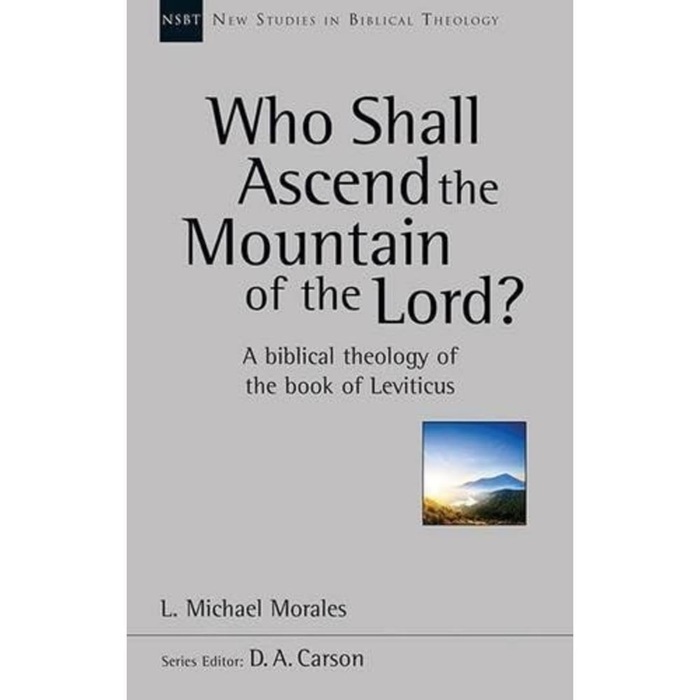
In this stimulating volume in the New Studies in Biblical Theology, Michael Morales explores the narrative context, literary structure and theology of Leviticus. He follows its dramatic movement, examines the tabernacle cult and the Day of Atonement, and tracks the development from Sinai's tabernacle to Zion's temple-and from the earthly to the heavenly Mount Zion in the New Testament. He shows how life with God in the house of God was the original goal of the creation of the cosmos, and became the goal of redemption and the new creation.
Addressing key issues in biblical theology, the works comprising New Studies in Biblical Theology are creative attempts to help Christians better understand their Bibles. The NSBT series is edited by D. A. Carson, aiming to simultaneously instruct and to edify, to interact with current scholarship and to point the way ahead.
Endorsements
Once in a while I will run into a book that feels like a revelation. Beale’s The Temple and the Church’s Mission (also in the NSBT series) was such a book; Who Shall Ascend is without a doubt another ... Every page is filled with multiple insights, some of them profoundly impacting ... Who Shall Ascend has the potential to revolutionise one’s reading of the Bible, and cause a hereto obscure book become understandable, even treasured. One can forgive Morales for pursuing a few (most interesting, some fascinating!) side-trails loosely related to his main points, as an excited tour guide is wont to do. At the risk of overstatement, Who Shall Ascend was so impacting that my reading of the Bible has been forever changed.
- Lindsay Kennedy
This is an exceptional piece of biblical theology ... Preachers will find this work a rich source of sermon material and all who are interested in the Bible will be amazed at its unity.
- Philip H. Eveson
Table of Contents
Series preface
Author's preface
Abbreviations
Prologue: The glory of God's house: the lampstand and the table of the Presence
1 Leviticus within the Pentateuch: a theological structure
Introduction
The structure of the Pentateuch
Conclusion
2 Longing for Eden: Genesis, the narrative context of Leviticus
Created to dwell in God's house: the Pentateuch's prologue
Deepening exile from the presence of God: the Pentateuch's plot
Excursus: cultic theology in the primeval history
3 Returning to Eden: Exodus, the narrative context of Leviticus
Redeemed through the waters: Exod. 1: 1-15: 21
Brought to the mountain of God: Exod. 15: 22-24: 18
Tabernacle, life with God: Exod. 25-40
Conclusion
4 Approaching the house of God: the dramatic movement of
Leviticus 1-10
Introduction
The narrative drama from Leviticus 1 to 10
Understanding the sacrificial cultus (Lev. 1-8)
5 Cleansing the house of God: the dramatic movement of
Leviticus 11-16
Introduction
The narrative drama from Leviticus 11 to 16
Understanding the laws on clean and unclean (Lev. 11-15)
Leviticus 16: the Day of Atonement
Excursus: Adam's fall
6 Meeting with God at the house of God: the dramatic movement
of Leviticus 17-27
Introduction
The symbolism of the lampstand and bread of the Presence
The dramatic movement of Leviticus 17-25
Understanding Israel's call to holiness (Lev. 17-22)
7 Establishing the earthly house of God: From Sinai's tabernacle
to Zion's temple
Introduction
Zion, mountain of God as Israel's inheritance
Exile and restoration
Conclusion
8 Entering the heavenly house of God: from the earthly to the
heavenly Mount Zion
Introduction
The ascent of Christ's humanity
The descent of Christ's Spirit
Conclusion
Bibliography
Index of authors
Index of Scripture references
Product Details
Title: Who Shall Ascend the Mountain of the Lord?: A Theology Of The Book Of Leviticus
Author: L. Michael Morales
Publisher: Apollos
Pages: 352
Binding: Paperback
Size: 21.7 x 13.9 x 2.6 cm
ISBN: 9781783593682